
Lafayette Escadrille
American Volunteer Pilots in WWI
By Stephen Sherman, Aug. 2001. Updated April 15, 2012.
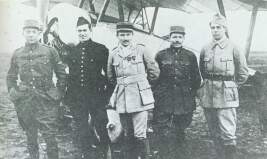
Before the United States entered the war in 1917, American sympathy for the Allies took many forms. One of the most famous was the Lafayette Escadrille, which started in April, 1916 as the Escadrille Américaine. As this name prompted German diplomatic complaints, it was renamed the Escadrille Lafayette. The fame of its thirty-eight American pilots exceeded their tangible impact; in 20 months, they downed 57 German planes, a solid, if unspectacular achievement.
In February, 1918, the Lafayette Escadrille was absorbed into the U.S. forces as the 103rd Pursuit Squadron. (Many Americans flew with other French units; in general, these volunteers were called the Lafayette Flying Corps.)
Beginnings
Dr. Edmund L. Gros, director of the American Ambulance Service, and Norman Prince, an American expatriate already flying with the French, got the squadron started. The French authorities stationed them at Luxeuil and provided them with a CO, Captain Georges Thénault, and some Nieuports, (thus the designation Nieuport 124 or simply N.124). Prince, Elliot Cowdin, James McConnell, Laurence Rumsey, Kiffin Rockwell, Victor Chapman, William Thaw and others of the initial group, settled themselves in luxury at the Grand Hotel. They selected an Indian head as their insignia, painted on the fuselages of their Nieuports. Dr. Gros recruited more experienced American aviators from French air units: Paul Pavelka, Didier Masson, Chouteau Johnson, Raoul Lufbery, Dudley Hill, and Clyde Balsley.
Combat
Kiffin Rockwell had the honor of the Americans' first aerial victory, a German two-seater L.V.G. on May 18, 1916. Shortly afterwards, the escadrille moved up to Bar-le-Duc, an airfield near Verdun. And soon, war no longer seemed like a romantic game. Rockwell, Bill Thaw, and Chapman suffered terribly bloody bullet wounds. Next Clyde Balsley was hospitalized with a leg injury. While flying to deliver some oranges to the hospitalized Balsley on June 23, Victor Chapman became the escadrille's first casualty. After this, they were sent back to Luxueil for more training. About this time, they adopted a lion cub, nicknamed "Whiskey," as their mascot; it was later joined by another, inevitably dubbed, "Soda."
On September 23, Kiffin Rockwell and Raoul Lufbery took their Nieuports (now equipped with the latest British interrupter gear) to the the front. They became separated and when Rockwell jumped a two-seater, its rear gunner sprayed him steadily and brought him down.
The French put the reckless Americans on bomber escort duty. On October 12, after a raid on a Mauser factory at Oberndorf, four Lafayette Escadrille pilots were assigned escort duty. Fokkers jumped the returning bombers, and Norman Prince got one, but while approaching an emergency strip, he snagged his landing gear in a power line. His Nieuport flipped over, mortally wounding Prince.
The call went out for more American volunteers; fifty more enrolled. In late 1916, Spads replaced the Nieuports, and redesignated S.124. By January, 1917, Raoul Lufbery had shot down seven German planes to become the leading American ace. Notwithstanding the aura of heroism that settled on the group, it was not without problems.
Eleven Americans who served with French air forces became aces:
- Raoul Lufbery (KIA), 16 --- N.124, none with U.S. 94th Aero Sqn.
- David Putnam (KIA), 13 ---
Spad 94, Spad 38; four with U.S. 139th Aero Sqn.
Born in 1898, Putnam, a descendant of American Revolutionary War General Israel Putnam, grew up in Jamaica Plain, Massachusetts. He joined the French Air Service at age 18, and scored his first victory in January, 1918, while flying with MS 156. By early June, he had four confirmed victories and many more unconfirmed. He transferred to Spad 38 and got two more confirmed kills, before moving over to the U.S. 139th Aero Sqn. He was shot down by the German ace Georg von Hantelmann in September, 1918. - Frank Baylies (KIA), 12 ---
Spad 3
Another Massachusetts native (from New Bedford), Frank Baylies was born in 1895. He served with the Ambulance Service into 1917. He volunteered for the Air Service and joined Spad 3, with whom he started scoring in February, 1918. - Paul Baer (POW), 9 --- all with 103rd Aero Sqn.
- Thomas Cassady, 9 --- five with Spad 163, four with U.S. 28th Aero Sqn.
- Ted Parsons, 8 --- seven with Spad 3, The Storks; one with N.124
- Gorman Larner, 7 --- two with Spad 86; five with U.S. 103rd Aero Sqn.
- Charles Biddle, 7 --- Spad 73, Spad 124, and 6 with U.S. units
- James Connelly, 7 --- Spad 157/163
- Bill Ponder, 6 --- three with French; three with U.S. 103rd Aero Sqn.
- Bill Thaw, 5 --- two with Lafayette Escadrille; three with U.S. 103rd Aero Sqn.
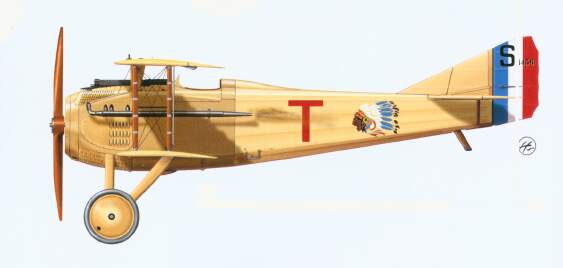
© Osprey Publishing Ltd, www.ospreypublishing.com, picture from Spad VII Aces of World War I
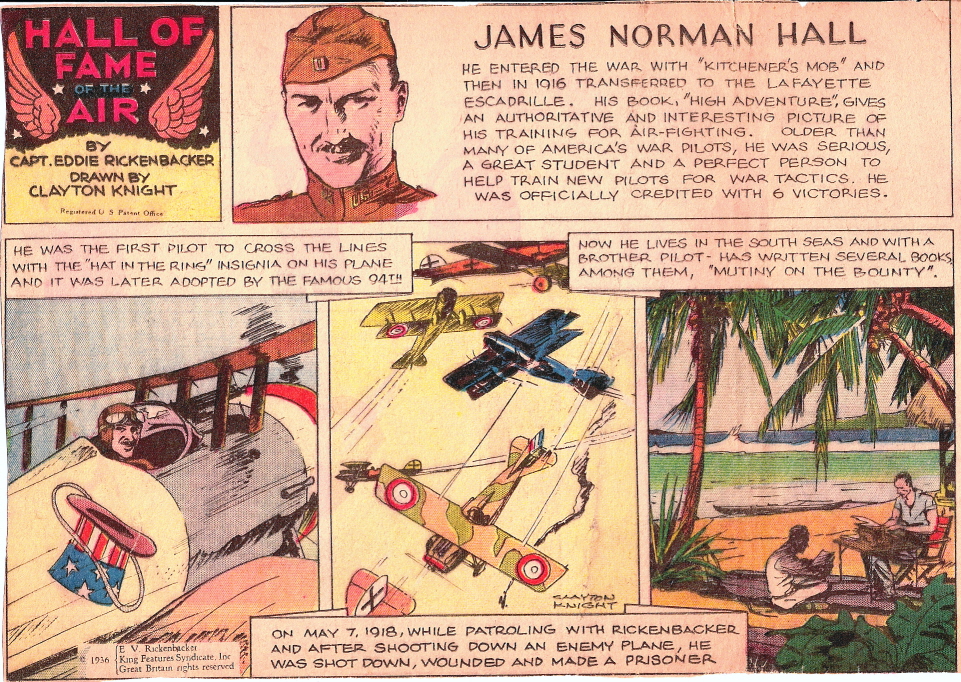
Two Lafayette Escadrille fliers, James Norman Hall and Charles Nordhoff, co-authored the world-famous Mutiny on the Bounty (1932) which has been filmed three times.
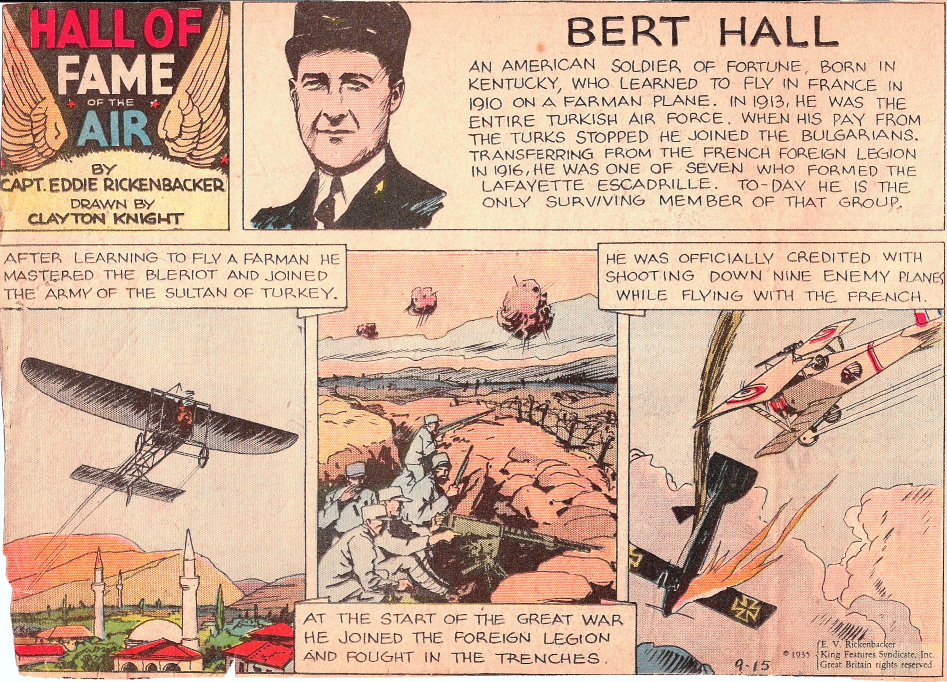
At the outbreak of World War I, Hall joined the British Army. He served in the 9th Battalion Royal Fusiliers, taking part in the Battle of Loos. His war memoirs Hall published in 1916 under the title Kitchener's Mob and High Adventure. Hall re-enlisted in 1916 as a member of the Lafayette Flying Corps, which was later incorporated into the United States Air Service. During these years he met Charles Nordhoff, a pilot serving in the same corps. In 1918 Hall was shot down behind the German lines and he spent the last six months of the war in a prison camp.
When Hall and Nordhoff received an advance from Harper's to write travel articles, they moved to Tahiti. In 1921 appeared their travel book Faery Lands of the South Seas. Hall continued with travel books and Nordhoff published novels. In 1925 Hall married Sarah Winchester, his friend had married a Polynesian woman a few years before.
In 1929 appeared Nordhoff's and Hall's jointly written book about flying, Falcons of France. After Hall's suggestion the team started to write Mutiny on the Bounty, the story about charismatic Fletcher Christian and Captain William Bligh. It was based upon factual events which were almost forgotten, although John Barrows had published in 1831 an account of the mutiny.
N.124 and Spad 124 both refer to the Lafayette Escadrille.
Sources:
- The Aerodrome
- Heroes of the Sunlit Sky, by Arch Whitehouse, Doubleday, 1967
- The Canvas Falcons, by Stephen Longstreet, Barnes & Noble, 1970
- Knights of the Air, by Ezra Bowen, Time-Life Books, 1980
- Rand McNally Encyclopedia of Military Aircraft: 1914-1980, by Enzio Angelucci, The Military Press, 1983
 Nieuport Aces of World War I, by Norman Franks
Another of the Osprey Aircraft of the Aces series, the second World War One topic. Forty colorful profile plates. Wonderful original period photos, including two of Albert Ball that I have never seen elsewhere. Two lengthy chapters on British and French aces. The book covers many aces with fewer than 15 kills, so it goes beyond the famous aces like Ball, Nungesser, Guynemer, and Rickenbacker. It covers the varieties of the Nieuport (11, 17, 28, etc.) in detail, down to the machine gunon the Type 11: a Lewis gun, of .303 caliber, carrying 476 rounds in its drum, and was mounted on the upper wing by a "Foster" mount, so named for the RFC sergeant who invented it. |
 |