
Fokker Dr.1 Triplane
The Red Baron's airplane
By Stephen Sherman, Aug. 2003. Updated April 15, 2012.
While it remains the most famous airplane of World War One, only 320 of the Fokker Dr.1 Triplane were built (compared to thousands of Spads, Nieuports, Albatroses, and Sopwith Camels). Inspired by the devastating performance of the Sopwith Triplane, Anthony Fokker designed and built the Dr.I Dreidecker, and delivered the first triplanes to Manfred von Richthofen's Jagdgeschwader I in late August 1917. After a brief familiarization flight, the "Red Baron" took aircraft number 102/17 up on September 1, and promptly shot down a British R.E.8 of No. 6 Sqn, whose crew probably thought the three-winged craft was a friendly Sopwith.
Fokker's new triplane was no mere knockoff of the Sopwith. It featured cantilever wings, supported by single interplane struts. Only the upper wing had ailerons. The initial order of twenty aircraft were numbered Dr.I 101/17 - 120/17. 300 later Dreideckers were numbered Dr I 121/17 - 220/17 and 400/17 - 599/17. Its twin, synchronized 8mm Spandau machine guns were standard firepower for the era.
Teething Troubles
Two weeks later, on Sept. 15, Kurt Wolff, a 33-victory ace of Jasta 11, was downed by Camels of 10 Naval Air Squadron, while flying the same aircraft, 102/17.
On the 23rd, Werner Voss, a young 48-victory ace, who was due to go on leave, took off in number 103/17, and met the SE5a's of Number 56 Squadron, in one of the legendary dogfights of the First World War. He single-handedly tangled with at least five British aces of that squadron, including James McCudden (57), Arthur Rhys Davids (25), and R T C Hoige (28). As described in McCudden's memoirs, Flying Fury: Five Years in the Royal Flying Corps, he brilliantly kept them at bay, and perforated every one of their planes. But eventually their numbers told, and Rhys Davids put a lethal burst in the tail of Voss's triplane.
The new triplane's troubles continued on October 30, when Gontermann's number 115/17 shed an upper wing and crashed. Gontermann died the next day of his injuries. Another pilot, Pastor, had the same problem with aircraft number 121/17 and also was killed.
All Dr I's were grounded in November, 1917, while Fokker worked on the structural problems. Tests showed that the ailerons' attachment points needed strengthening and that the upper wings glue joints had been weakened by poor quality control. Fokker fixed these problems within the month. Both ground and aerial combat diminished in the 1917-18 winter, and the German offensive of Spring 1918 saw the heyday of the Fokker Triplane. As it was produced in small numbers, the Dr.1 never became the primary mount of most Jastas.
Markings
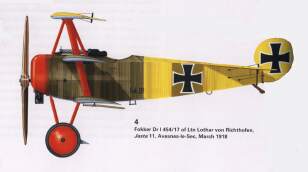
The typical Dr.1 was painted in a streaky olive-brown camouflage, over the a factory-finish light blue. To this, the Jastas added their distinctive unit markings, typically on the tail and spinner. Jasta 11 triplanes featured red spinner, wheels, struts, and tail. Jasta 2 "Boelcke" painted the spinner and wheels black, with white tails. Jasta 12 featured white spinners and black tails, with the struts left in factory blue, and the fuselage and wheels in olive-brown.
SOME OF THE ACES THAT FLEW THE Dr.1 INCLUDE:
Werner Voss, 48 victories, Jasta 2 & 10
Kurt Wolff, 33 victories, Jasta 11
Lothar von Richthofen, 40 victories, Jasta 11
An impulsive and aggressive pilot, unlike his cooly calculating brother Manfred, he scored 24 victories in his first six weeks (April - May, 1917) with Jasta 11. In mid-May, he was promoted to commander of Jasta 11, received the Pour le Mérite (the Blue Max), and was badly injured, putting him out of combat until November.
He apparently only scored three victories while flying the Dr.1, on
March 11 and 12, 1918. On the 12th, the fliers of Jasta
attacked ten Bristol F2B's; at one point in the dogfight, Lothar was
compelled to dive away. At lower altitude, he engaged one of the
British two seaters in a head-on duel, especially dangerous because, if
the planes passed each other, the F2B observer could rake the triplane
with
machine gun fire. But von Richthofen's gunfire hit first, and the
Brisfit caught fire; both crew jumped out. He shot down a second F2B a
few minutes later.
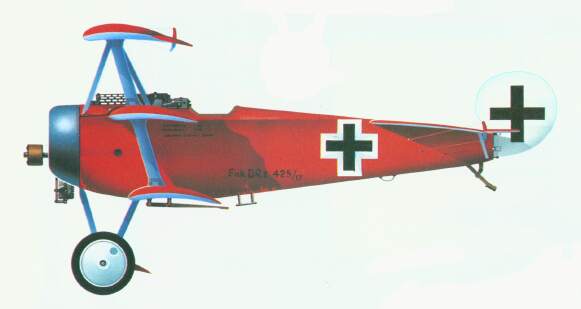
Illustrated is a Fokker Dr. 1, built 1917, powered by a Thulin- built Le Rhône 9J 9-cylinder air- cooled rotary 110 HP engine, weight 1,289 lbs., max. speed of 103 mph, ceiling of 19,685 feet, 2 synchronized Spandau machine guns.
March 13, 1918
The next day, flying Dr.1 number 454/17, he tangled with more Brisfits from No. 62 Squadron. He was hit and his upper wing failed; although his later claim, "my triplane became a biplane" was exaggerated, as crash photos show. He struggled to bring the plane down, while avoiding some high tension wires and a group of soldiers. He crashed landed and was hospitalized with facial injuries, out again for four months.
Paul Bäumer, 43 victories, Jasta 2 "Boelcke"
Bäumer was credited with four victories in March, 1918, when he was flying the Fokker triplane, usually #204/17 and #209/17, although he may have also used an Albatros D.V that month. The maneuverability of the rotary-engined triplane suited Bäumer's close-in style of fighting. On March 9, he claimed his first British plane (a Sopwith Camel) in the triplane (#204/17). Flying over Becelaere in the late morning, Bäumer and four comrades attacked a flight of Sopwiths at 6000 feet. The dogfighting brought the planes down to 4500 feet, where one of the Sopwiths flew at Bäumer. He reported that his gunfire sent his opponent crashing down. No. 65 Sqn Camels reported an attack by Dr.1s, but none were, in fact, lost.
March 23, 1918
On this day, Bäumer shot down three planes, a Camel in the morning while he was flying an Albatros, and, in the afternoon, two RE8's.
Karl Bolle, 36 victories, Jasta 2 "Boelcke"
Josef Jacobs, 47 victories, Jasta 7
Adolph von Tutschek, 27 victories, Jasta 12
Sources:
- Pilots and Planes of World War One
- The Aerodrome
- Heroes of the Sunlit Sky, by Arch Whitehouse, Doubleday, 1967
- The Canvas Falcons, by Stephen Longstreet, Barnes & Noble, 1970
|
Fokker Dr I Aces of World War 1 , by Norman
Franks, Harry Dempsey
Undoubtedly the most famous fighter of World War 1, the Fokker Dr I was a revelation when it entered service on the western front in 1917. Manfred von Richthofen’s JG 1 was the first Jasta to completely re-equip with the new fighter, and in the skilled hands of its numerous aces the Dr I proved a formidable opponent. The Dr I remained in service on the Western Front until replaced by the superior Fokker D VII in May 1918. Just weeks prior to that, however, Germany’s leading ace, the great ‘Red Baron’, had been killed at the controls of a Dr I. The revolutionary triplane design adopted by Fokker was inspired by the equally successful Sopwith’s Triplane, and although built in remarkably small numbers, the Fokker Triplane legend has made it the best known aircraft to emerge from World War 1. ‘Fokker Dr 1 Aces of World War 1’ features 40 original profiles, along with scrap views and planforms, all specially commissioned for this volume. |
 |