
The Zeppelin Raiders
An Excerpt from The Years of the Sky Kings, by Arch Whitehouse
By Arch Whitehouse, 1964. Updated April 16, 2012.
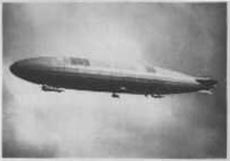
The year of 1915 was marked by the heavy attacks on London and other British cities by raiding German Zeppelins. It was the first time in history that this type of warfare on helpless civilians was perpetrated, and there was little to be done about these giant gasbags, since practically nothing had been accomplished toward developing a high-angle anti-aircraft gun, and the existing aeroplanes were not capable of rapid climb. There was no radar, and all the Germans had to do was to take off from their sheds in occupied Belgium, climb to a favourable wind level late in the afternoon, and cut their engines. The wind would carry them in silence over the North Sea, so they generally arrived over Britain in the early darkness. Once they had released their racks of high explosives, they simply soared to a greater height and turned their noses for home.
As may be surmised, the prospects were not cheerful. For months the Allies had suffered reverse after reverse. The British still remembered Mons, as they were to remember Dunkirk a quarter of a century later. They had won at Neuve-Chapelle, but at what a cost! The Germans had staged their first poison-gas attack, and the British were still searching for a reliable gas mask.
This new atrocity, only tersely announced, aroused fresh suspicions. At home they had experienced the general blackout for the first time. Raiding Zeppelins, blackouts, and censorship? What next? The Germans must be at the Channel ports! What could be believed? If the gas attack at Ypres was censored, how much could be credited concerning the reported damage inflicted by the Zeppelin raids? What was to stop the Germans from bombing London clean off the map or drenching the chief cities with his poison gas?
Warneford
By June of that year the British were as near morale disintegration as they have ever been. Fortunately confidence was restored by a schoolboyish youngster, Reginald Alexander John Warneford. The searching finger of Fate could not have selected a more British candidate for the hero's role of this early war drama.
Reg Warneford was a lively composite of the Commonwealth of Nations. His parents were cheery Yorkshire types who rattled about the Empire on various missions and pretexts, and Reg was born in India, educated at the English College in Simla, at Stratford on Avon Grammar School in England, and at an unnamed lyceum in Canada. Although his formal education was devoted to the arts and classics, Reg appears to have shown a marked preference for motor cycles, odorous chemical experiments, and mountain climbing.
When the news of the war reached him in Canada he broke out of the lyceum and raced for England. First he joined the much-publicized Sportsmen's Battalion, an infantry unit made up of well-known sporting and athletic figures, but the Sportsmen's Battalion was slack in unfurling its battle flags, and Reggie discovered that headlined athletes are usually physically attuned only to sport -not war. Fearing the conflict would end before the athletes were whipped into combat condition, he put in for an immediate transfer to the Royal Naval Air Service. He made a good selection, for by June 1915, less than eleven months after the opening of hostilities, he was a Flight Sub-Lieutenant with No. 1 Squadron at Dunkirk.
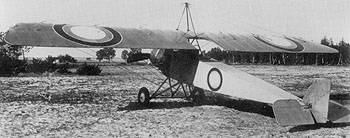
Half a dozen solo flights on a Morane Parasol, and young Warneford was tabbed for honour and glory. It must be admitted that World War I seemed to be designed for men who wanted fast action. Like Warneford, most flyers were afraid it would peter out any minute-and they'd all have to go back to school or work again.
First Raid over London
On the evening of May 21, 1915, Hauptmann Karl Linnarz, a noted Zeppelin commander, carried out the first successful raid on London. He had taken off from an airship base located at Evere just north of Brussels, gained operating altitude over his field, and then allowed a friendly breeze to drift him in silence over the British Capital.
London watched the inadequate defences go into action. The searchlights lanced the skies but were unable to pick up the raider. The ineffective pom-poms grunted and growled but only showered the suburbs with jagged shrapnel. A few Home Defence flyers took off to do battle, but as usual nothing happened. The warning sirens shrieked and died down. The pungent smoke pall seeped across the Thames, and hurriedly organized rescue teams clambered through the wreckage, cursing a government that had failed to anticipate this form of warfare.
However, at a secluded airstrip across the Channel something new had been added, a special anti-airship Squadron at Dunkirk. A hundred feet below the homeward-bound Zeppelin-dramatically highlighted by the yellow-blue exhausts of its four Maybach engines- cruised a tiny high-wing monoplane flaunting the new red, white, and blue of the British service. A series of smudged flame flicks spat out from the oval cockpit below the centre-section cutout. Gunfire! They were single shots of desperation from a cumbersome shoulder weapon, but alarming and disconcerting, nevertheless. After all, LZ.38's ballonets were filled with hydrogen, and it took only a single bullet to produce a spark.
Hauptmann Linnarz rushed to his control board and bellowed for emergency measures. As soon as his gasbag had lifted to safety he became the militant Prussian once more. He took a neatly engraved calling card from his wallet and on it scrawled: "You English! We have come and we will come again soon to kill or cure! Linnarz." He snatched a weighted message streamer from a flag locker and inserted the card and message in the stitched pocket. "See that this is dropped as near the Dunkirk aerodrome as possible. We will fly over it on crossing the coast line."
Four thousand feet below. Lieutenant R.H. Mulock of No. I Naval cut his gasping Le Rhône engine and eased into a gentle glide. He'd given it a try, but the little Morane Parasol was unequal to the task.
"There's no use trying to swat one wasp with a wisp of straw," Mulock later reported to his C.O., Commander Spenser Grey. "A wise man would pour a kettle of hot water down the hole and scuttle the lot. That's what we've got to do. Blast them out of their bloody sheds." From that night on. No. I Naval planned a new strategy and, to add a dash of personal competition and squadron animosity to the proceedings, a wandering navy artificer beachcombing along the Dunkirk dunes the next day came across Hauptmann Linnarz's insulting message. He turned it over to Commander Grey, and the boys at No. I Naval accepted the challenge.
When the Royal Naval Air Service first took over its base at Dunkirk, Spenser Grey decided to disperse the few machines allotted to him. Dunkirk was too obvious a target, but Furnes, just across the French-Belgian border, was less conspicuous.
One three-ship flight under Lieutenant J. P. Wilson was therefore accommodated in three single canvas hangars set on the edge of a lush meadow, and there Wilson and Sub-Lieutenants Mills and Reg Warneford made up the duty roster.
Their mounts were stripped- down versions of the French Morane-Saulnier observation planes. The high wing was given a sharper angle of attack for climbing, one seat was covered over, and a primitive form of bomb rack was bolted beneath the fuselage. Because of its weird wing arrangement, the British pilots had long dubbed it the Parasol. This Morane machine was as flighty as its name, tricky on the controls and devilish to land. It was relatively fast as a single-seater and powered with an 80-h.p. Rhone engine. Other than the six so-called fire bombs and a light carbine borrowed from the Belgian Army, she carried no offensive armament.
The Night of June 6-7
On the afternoon of June 6 Wilson's Furnes flight reported to Dunkirk, where Spenser Grey had set up a council of war. The C.O. explained Mulock's abortive brush with the Zeppelin that had bombed London and impressed his flight leaders with the obvious impossibility of engaging Zeps in the air. Then Grey fluttered Linnarz's message streamer and belligerent calling card.
"The man who dropped this challenge played merry hell over London less than a week ago. Mulock did his best, but this Hun Linnarz returned to his shed at Evere unscathed."
"You are sure this calling-card bloke and his gasbag are located at Evere?" Wilson broke in.
"That, we know. Keep thinking along those lines, Wilson. Just one night attack might be very useful." It was pretty obvious what Spenser Grey and J. P. Wilson were considering.
On the way back to Furnes young Warneford explained to Wilson that be had never been off the ground at night, but Wilson insisted they were taking off as soon after midnight as possible.
True to his word. Lieutenant Wilson had his flight ready and waiting on the oil-stained turf by midnight, the racks were glutted with fire bombs, and the Belgian carbines rested in the brass prongs beside the cockpits.
Warneford was flagged off first, and before he realized what he had signed up for his Morane was well off the ground. He stared wide-eyed and then peered, trying to find the small grouping of instruments. A length of scarlet worsted knotted to a centre-section strut was flicking insistently at his nose, and he quickly realized this very primitive indicator was warning him that he was already in a dangerous sideslip. Gradually his eyes became accustomed to the yellow-grey nothingness below his Triplex windscreen, and he fixed his gaze on the white needle of the altimeter. He was already at 3,000 feet.
He looked around for some evidence of Wilson and Mills. There was nothing anywhere but the exaggerated roar of the Le Rhône and the drip-drip-drip of condensation off the centre-section that needled his cheeks like a fretsaw blade. Below hissed a poisonous glow that he had never encountered before-it was the blue-yellow flame of his exhaust. His indistinct compass float, dancing in a small window placed, in the bulge of the centre-section, showed something that looked like the letter W. Encouraged by this, he risked a turn, hoping to pick up his flight mates.
He circled and circled for some minutes, but no sign of Wilson or Mills rewarded his patient patrol. Meanwhile he was becoming adjusted to his strange experience and as the area remained fairly clear he wondered whether, regardless of his failure to contact his flight leader and companions, he might make himself useful. He had about decided to search for the Berchem-
Sainte-Agathe airship shed, which he remembered was located just west of Brussels, when something caught his eye a few miles to the north. He blinked and looked again. That something was emitting the same blue-yellow flame as his Le Rhône. If that was Wilson and Mills, what the devil were they doing up there toward Ostend? And what in heaven's name was that long black mass floating above them?
Wilson and Mills had made immediate contact with each other and soon cleared the fog around Fames to head east for Brussels, 75 miles away. On finding clear sides, Wilson decider to fly direct for Evere on the north side of the old Flemish city, and together they hit their objective on the nose. Circling the shed area once, Wilson went in first, mainly to start a fire and give Mills a pathfinder target. He released three of his bombs but only created a billowing smoke pall. By then the German defence gunners woke up and began plastering the sky with high-angle gun explosive, at which point Wilson discovered his last three bombs had become hung up in the primitive rack. Young Mills finally went in. Parasol wings fluttering, to dare the ground fire and pulled his bomb plug. All six of his 20-pounders slid clear, and he was rewarded with a gigantic explosion that illuminated the sky for miles around. Wilson, who had conceived and planned the raid, had to return with little to show for his effort.
Two weeks later British Intelligence, working out of Antwerp, reported that Hauptmann Linnarz's LZ.38 -- the same airship that had first bombed London -- had gone up in flames during the raid on Evere. Thus the R.N.A.S. scored revenge for that caustic calling card.
LZ.37
That same night the LZ.37, commanded by Oberleutnant von de Haegen, had been ordered to carry out a routine patrol stretching from Ghent to Le Havre. There was nothing particularly offensive about the flight, for it was originated mainly to give a number of airship designers, specialists, and technicians from the Zeppelin factory first-hand knowledge of the various problems experienced by the crews on active service.
The LZ.37 was 521 feet in length and her eighteen main gas ballonets carried 953,000 cubic feet of hydrogen. She was powered by four new 210-h.p. Maybach engines and manned by a select crew of twenty-eight highly skilled airshipmen. For defence her designers had provided four machine-gun posts built into the out- board engine gondolas. These positions provided good visibility, a fairly wide arc of fire, and complete defence along both sides of the airship.
Unequal Midnight Duel
After Warneford had been flying north for a few minutes he stared in amazement at what he had stumbled onto-a Zeppelin that seemed half a mile long! He had to twist his head from west to east to take in its leviathan proportions. From its underside were hung several glistening observation cars, and the gleam from fantail exhausts indicated that the rubberized covering was daubed a yellow-ochre colour. Warneford wondered what the devil kept a thing that big in the air at all. But there was no time for reflection as the Zeppelin's machine guns opened up and the slugs clattered through the frail wings of Morane Parasol No. 3253.
Warneford wisely heeled over and cleared off out of range. He glanced around and saw that the fog was breaking up below and he could see the Ostend-Bruges Canal. The big gasbag was apparently headed for Ghent. The observation cars seemed twice as large as his Parasol fuselage.
Then, to his amazement, the big snub-nosed gasbag shifted course and came roaring on toward him. Two more streams of tracer-flickering machine-gun fire snapped from the forward gondolas and converged only a few yards from the Parasol. He gave the Le Rhône all she could gulp and tried to climb, but the crisscrossing tracers pencilled in a definite warning, and he had to peel off and dive. He sat and studied the situation and wondered what his carbine would do if he could hit something particularly touchy. After all, hydrogen burns.
He flailed the little Morane back and took the carbine from its prongs. Manoeuvring to a point under the mighty elevator and ladder framework, he gripped the control stick between his knees, and then, sublimely confident that he had not been. seen, he began triggering off a few .303 shells at the massive target above and ahead. the first clip of cartridges was soon spent and nothing untoward had happened.
For the next few minutes he stalked the LZ.37 and popped away with his carbine, but it was like aiming at a cyclone-propelled haystack with an air rifle. Whenever he came within range or within view, the German gunners sprayed the sky about him with generous bursts of Parabellum fire, and time after time the impudent young Englishman was driven off.
Warneford's Pursuit
Von de Haegen then played it safe and dumped some water ballast over Assebroek and left Warneford still potting away impotently at 7,000 feet. From there the Zep commander upped his speed and roared away for Ghent.
Warneford realized what had happened but refused to admit defeat. Instead he settled back to keep the Zeppelin within view and gain some valuable height.
It was a race for safety for the LZ.37, and while von de Haegen maintained his altitude Warneford was helpless; but this was not an ordinary mission. The German commander began to worry about his V.I.P. passengers when he should have concentrated on maintaining his safe tactical procedure.
By 2.25 a.m. the Morane Parasol pilot, still stalking and trying to get. above the Zeppelin, was delighted to see the big airship suddenly nose down and apparently head for a break in the 7,000-foot cloud layer that spread toward Ghent. He had browbeaten his plane up to 11,000 feet, hoping he might get into a position where he could use his fire bombs, since he had expended all his carbine ammunition. Now the LZ.37 was actually below him and for the first time he realized that the upper cover was painted what seemed to be a dark green and that there was nothing resembling a gun turret on the top that could harass him. The other guns were in the underside gondolas and he was shielded from them by the bulging sides of the main framework.
She looked so big as he moved into position for his run-in, he felt he could make a landing on her topside. The ground smear that was Ghent lay below and slightly to the east when the gnat-like Morane nosed down for the 500-foot top panel of the LZ.37. He must have chuckled to himself as his wheels passed over the high elevator and rudder structure.
Destruction!
One . .. two . . .three! he counted as the Morane jerked with the release of each bomb.
He said later that be had fully expected the Zeppelin to explode immediately when his first bomb pierced the envelope.
Four . . . five! He continued to count, and then a gigantic explosion ripped through the upper panel covering, baring the indistinct details of the framework.
Completely spellbound, he continued his run-in until the little Morane was swept up on a savage belch of flaming concussion. It whipped over with a violence that would have catapulted Warneford out of his cockpit had it not been for his safety belt. He gasped in astonishment, rammed the stick forward, and tried to get her into a dive. Chunks of burning framework hurtled by as he gradually floundered out of the aerial convulsion and streaked down through a great pall of choking smoke. The next few minutes were devoted to skimming clear of the debris, getting back on even keel, and frantically adjusting his air and gas mixture to overcome a series of warning pops from his Le Rhône.
A few seconds later the doomed airship fell on the convent of Saint Elizabeth in the Mont-Saint-Amand suburb of Ghent. One nun was killed outright and several women were badly burned, but the helmsman of the Zeppelin had a most remarkable escape. According to eye-witnesses, he actually jumped clear of the tumbling wreckage at about 200 feet, landed on the root of the convent, crashed through it as though it had been made of matchwood, and landed in a unoccupied bed. He suffered only minor injuries and was the only crew member or passenger of the ill-fated LZ.37 to live.
Warneford's Escape
At 7,000 feet above this widespread carnage Warneford sat waiting for his wings to part company with the fuselage. The Le Rhône snorted its wrath and contempt, and quit cold! The gleaming wooden prop wig-wagged to a halt as he calculated that he was at least 35 miles inside the German lines. There was nothing else to do but accept the bitter inevitable and go down. In spite of the darkness and the lack of ground flares, the young flyer landed the battered machine safely in an open field that was shielded on one side by a long patch of woods. There was a darkened farmhouse nearby, but no one appeared to question his unscheduled arrival.
His first impulse was to destroy the plane but an investigation of the tank disclosed there was ample fuel to get him back across the line to Furnes, and further probing indicated that his violent acrobatics had broken the fuel line. He figured there was still a chance to escape. A quick search through his pockets produced a cigarette holder. The outer end was just what he needed, so he broke it off, fitted it to form a journal at the original break, and bound it secure with strips of a linen handkerchief. An experimental tug on the prop assured him that sufficient fuel was reaching the carburettor, so he decided to start the engine himself. The Le Rhône, of course, was still warm, and after two complete revolutions of the prop to suck in petrol he cut in the switch and snapped her over. The engine caught immediately and it was something of a scramble to get into the cockpit, but he managed it and roared away.
Approaching the coast again, he encountered more fog so he tooled up and down until he found a hole and dropped through. At 3.30 a.m. he checked in at Cai Gris-Nez, 10 miles below Calais, where he picked up more fuel and called his squadron headquarters at Dunkirk.
He sat out the bad weather and finally returned to Furnes at 10:30 a.m. By that time the jubilant news was widely known and within hours his name was ringing from one end of the Empire to the other. All that week his photograph was flashed on hundreds of theatre screens to the delight of cheering audiences.
That afternoon, in keeping with the traditions of the Silent Service, Commanding Officer Spenser Grey of No. I Naval Squadron posted a notice which read:
Though weather has been extremely unsettled, our pilots have been active and busy
The next day King George V recognized Warneford's victory by awarding him the Victoria Cross, and the French government followed that decoration with their Cross of the Legion of Honour.
England tightened its belt from that day on and took a brighter view of the Zeppelin menace. Many more raiders would come and more devastation would be wrought, but now there was assurance that some young Britisher would mount the sky and take them on. Many more Zeppelins were destroyed before the Kaiser capitulated, and many other young men - Leefe-Robinson, Tempest, Cadbury, Sowrey, Leckie and Pyott - came along to take up Warneford's torch. All of them were great names in those days.
But Flight Lieutenant R. A. J. Warneford lived only ten more days to enjoy the laurels of his victory. He went to Paris on June 17 to receive his Legion of Honour and after the ceremony was ordered to pick up a new Farman biplane at the Buc aerodrome outside the French capital. The machine was brand new - so new in fact that much of its standard equipment had not been fitted - but most important, there were no safety belts in either seat.
An enthusiastic American newspaperman named Needham had asked to go along to Furnes, where he planned to write a story about Warneford and his Zeppelin victory. Warneford cheerfully agreed and they climbed in the biplane and took off. Almost immediately, for some unknown reason, the Farman pitched and bucked and both Warneford and Needham were thrown out in mid-air and killed. And so ended the brief but illustrious record of the first British airman to destroy a German zeppelin in the air.
Leefe-Robinson
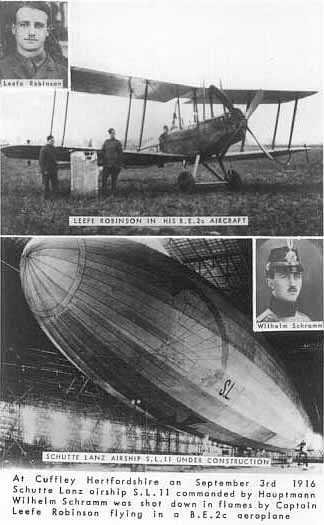
Following the Warneford Zeppelin triumph, there were dozens of fabulous reports of other gasbag conquests. One of the most fantastic that persisted for weeks was that Roland Garros, the French ace, had tried to down a Zeppelin over Paris with his new gun, but when he failed with ordinary gunfire he boldly rammed the raider, flying his Morane Bullet straight through the massive framework and coming out the other side, leaving a jagged outline of his machine. After that, the Zeppelin folded in the middle and dropped in a French cornfield. There was, of course, nothing to the report, but faked photographs of this astounding adventure were on sale all over France for several weeks. The myth of the Allied pilot who flew through a Zeppelin persisted for some time, but no more Zeppelins were downed for more than a year when a B.E.2c pilot of No. 39 Squadron, Royal Flying Corps, Lieutenant W. Leefe-Robinson, repeated Warneford's performance. In this case, however, he scored his victory on the evening of September 2-3, 1916, in sight of a million pairs of British eyes, and piled up the wreckage for all to see near the little village of Cuffley in Middlesex, whereas Warneford's action took place over the other side of the North Sea. Strictly speaking, the airship brought down was not a Zeppelin. It was a dirigible of the old Schutte- Lanz type. It had a maximum speed of about 60 miles an hour, but for purposes of fuel conservation this speed was seldom used; the cruising speed of 40 miles per hour was more usual. Its maximum altitude, by jettisoning its war load, was about 15,000 feet.
Leefe-Robinson was also born in India of British parents, in 1895, and when the family returned to Britain he was educated at St. Bee's School in Cumberland, a small academy that produced three Victoria Cross winners. After considerable travelling in France and Russia he entered Sandhurst military college in August 1914. The following December he was gazetted to the Worcester Regiment, but by March 1915 had transferred to the Royal Flying Corps where he served as an observer. On May 9 he was wounded in the right arm on a patrol near Lille, and when he had recovered he was posted to a flight training school at Farnborough, England, and took his ticket the following September. He was eventually assigned to No. 39 Squadron, a Home Defence unit located at Sutton's Farm.
By this time, while no longer in dread of the Zeppelins, the people of Britain were looking askance at the anti- aircraft defences the politicians and War Office martinets were bragging about. The Zeppelins were again raiding Britain almost nightly, and the civilian casualty roll mounted. Month after month passed and no one bad emulated Reg Warneford's feat. In truth, the gasbag invaders were enjoying some immunity, but by the same token they were not scoring on important military points.
As in World War II these raids, although spectacular and damaging from the point of view of the general population, were not seriously hindering the over-all war effort.
The population was suffering mainly from sleepless nights. Then on September 3, 1916, in full view of the Metropolis a giant raider fell in a roaring mass of flame. It struck the ground at Coffley, Middlesex, and the entire crew of sixteen died as millions of Londoners cheered the unknown hero who had sent it to its fate. In an hour all roads leading to Cuffley were thronged with the curious who rushed to see the remains of the first raider shot down on English soil.
Shortly after eleven o'clock on September 2 the Maybach engines of these dirigibles, were first heard over the keeping countryside. It was a beautifully clear night with few clouds floating across the sky. The stars looked down with cool aloofness. Gradually the higher-pitched notes of the Home Defence B.E.2c's screeched across the skies in search of the raiders. Just after one o'clock a probing searchlight picked out a long, glowing pencil of light as it approached Woolwich Arsenal. There was no mistaking it, and other searchlights swept across the war-stricken sky and joined the first. Lieutenant Leefe-Robinson saw the dirigible held aloft on a tripod of blinding silver, and, although he was in danger of being hit by his own shells, he raced in to the attack.
This is his story as he scrawled it on a sheet of patrol report paper:
From: Lieutenant Leefe-Robinson,
Sutton's Farm.
To: The Officer Commanding
No. 39 H. D. Squadron.
Sir:
I have the honour to make the following report on night patrol made by me on the night of the 2-3 instant. I went up at about 11.08 p.m. on the night of the second with instructions to patrol between Sutton's Farm and Joyce Green.I climbed to 10,000 feet in fifty-three minutes. I counted what I thought were ten sets of flares - there were a few clouds below me, but on the whole it was a beautifully clear night. I saw nothing until 1.10 a.m., when two searchlights picked up a Zeppelin S.E. of Woolwich. The clouds had collected in this quarter and the searchlights had some difficulty in keeping on the airship. By this time I had managed to climb to 12,000 feet and I made in the direction of the Zeppelin - which was being fired on by a few anti-aircraft guns - hoping to cut it off on its way eastward. I very slowly gained on it for about ten minutes. I judged it to be about 800 feet below me and I sacrificed some speed in order to keep the height. It went behind some clouds, avoiding the searchlight, and I lost sight of it. After fifteen minutes of fruitless search I returned to my patrol.
I managed to pick up and distinguish my flares again. At about 1.50 a.m. I noticed a red glow in the N.E. of London. Taking it to be an outbreak of fire, I went in that direction. At 2.05 a Zeppelin was picked up by the searchlights over N.N.E. London (as far as I could judge).
Remembering my last failure, I sacrificed height (I was at about 12,900 feet) for speed and nosed down in the direction of the Zeppelin. I saw shells bursting and night tracers flying around it. When I drew closer I noticed that the anti- aircraft aim was too high or too low; also a good many shells burst about 800 feet behind-a few tracers went right over. I could hear the bursts when about 3,000 feet from the Zeppelin. I flew about 800 feet below it from bow to stem and distributed one drum among it (alternate New Brock and Pomeroy). It seemed to have no effect; I therefore moved to one side and gave them another drum along the side - also without effect. I then got behind it and by this time I was very close - 500 feet or less below, and concentrated one drum on one part (underneath rear). I was then at a height of 11,500 feet when attacking the Zeppelin.
I had hardly finished the drum before I saw the part fired at, glow. In a few seconds the whole rear part was blazing. When the third drum was fired, there were no searchlights on the Zeppelin, and no and-aircraft was firing. I quickly got out of the way of the falling, blazing Zeppelin and, being very excited, fired off a few red Very lights and dropped a parachute flare.
Having little oil or petrol left, I returned to Sutton's Farm, landing at 2.45 a.m. On landing, I found the Zeppelin gunners had shot away the machine-gun wire guard, the rear part of my centre section, and had pierced the main spar several times.
I have the honour to be, sir,
Your obedient servant,
(Signed) W. Leefe-Robinson, Lieutenant
No. 39 Squadron, R.F.C.
Once again the hero of the hour did not long survive his victory. On April 5, 1917, Leefe-Robinson was posted to No. 48 Squadron, the first R.F.C. outfit to fly the new Bristol Fighter. Flying as a flight commander (captain), he saw his six-plane flight attacked by a Fokker circus. Instead of breaking up and flying as fighter scouts, Leefe- Robinson's flight tried to fly the old two-seater Lufbery circle (nose to tail) formation and were badly cut up. It was the first and last time that the Bristol Fighter was so misused. Leefe-Robinson's engine was damaged and he had to land in enemy territory, where he was taken prisoner, spending most of the war in various German prisons including the infamous Holzminden, where for a time he was kept in solitary confinement. His health became undermined - he was hardly the rugged physical type - and shortly after being returned to his home in England fell a victim to one of the influenza epidemics. This courageous young man who gave London its most dramatic war spectacle made no spectacular exit himself. He died in bed on January 31, 1918.
Summary of Zeppelin Raids
London was the principal objective of the First World War Zeppelin raids, and between 1915 and 1918 no less than 208 airship sorties were carried out against Britain, a total of 5,907 bombs were dropped, 528 people were killed (mostly civilians), and more than 1,000 were wounded. The peak of the Zeppelin's threat was during 1915 and 1916, for during those two years 168 sorties were carried out against Great Britain, killing 115 people and wounding 324 in London. In the rest of England, 361 were killed and 692 wounded. In 1917 and 1918 the airship threat practically came to an end; only thirty sorties were made in 1917, and ten in the last year of the war. The explanation is that Great Britain greatly improved her anti-aircraft gunnery, searchlights, and her warning system. A seldom-published item of interest is that many of the ground observers employed along the British east coast to detect the oncoming airships and aircraft were blind people, selected because of their acute hearing. It was probably the most rewarding task any such afflicted person has undertaken.
Late 1916
After Leefe-Robinson's success against S.L.II the Home Defence squadrons seemed to be inspired. On September 23, 1916, eleven airships, including three new super-Zeppelins, left their sheds in Belgium and headed for the Essex coast.
About midnight L.33 was over East London and had dropped twenty bombs. This time, however, the defence reacted fast and almost immediately L.33 was caught on a cone of searchlights and was riddled by the ground guns. One of her engines was damaged and she began to fly a very erratic course, and to add to her miseries a Lieutenant A. G. Brandon of the R.F.C. hove out of the night and for twenty minutes slugged her with machine-gun fire. As she laboured her way back to the North Sea the crew jettisoned everything that could be tossed overboard, but she never reached the Belgian coast line and was lost in the sea.
The famous Commander Mathy, aboard L.31 in company with L.32, crossed the English Channel and cruised over toward Kent, flying boldly on to the centre of London. Mathy dumped bombs on northern London and escaped. The L.32, however, was not so bold and spent some time circling the Romney marshes and finally crossed the Thames at Dartford, where it was picked up by searchlights. At this point Lieutenant Frederick Sowrey attacked with a machine gun and sent it down in flames near the village of Billericay. He had to be content with the Distinguished Service Order.
The bold Captain Mathy lived a charmed life. He seemed bullet-proof, and night after night, weather permitting, he would invade Britain from one direction or the other. He did not always float over to drop bombs; sometimes he would simply drift about making an important reconnaissance. One never knew whether he would come to London from the industrial north or appear suddenly over the Isle of Wight and fly inland from the English Channel.
On board the L.31 on the night of October 1, 1916, Mathy led a formation of eleven dirigibles and this time he first appeared over Lowestoft on the east coast at about eight o'clock and as usual steered a deliberate course for London. Soon after passing Chelmsford, he discovered that the outer London defences were ready for him, so he turned north-east until the furor died down. Then with a quick decision he turned south-west with the idea of getting into position for another dash across London. After drifting quietly in the vicinity of Ware, he started his engines again and headed for the northern fringes of the capital.
The ground defences had been just as wary, and the minute his engines opened up, the guns below responded and Mathy had to turn away, but unfortunately for him Second Lieutenant W. J. Tempest had struggled up to 12,700 feet while stalking the Mathy airship. He attacked resolutely in the face of heavy gondola machine-gun fire, and the L.31 went down in flames, piling up on the outskirts of Potters Bar. This was the last time a German dirigible attempted to attack London, After that the Germans gave their attention to the industrial areas in the north.
Then on the evening of November 27, 1916, eight dirigibles reached the British coast line, one being immediately destroyed on the coast near Hartlepool by Captain J. V. Pyott of the R.F.C. Another raider, L.21, was caught by anti-aircraft fire as she was leaving the coast of Yarmouth. This airship broke up at 8,000 feet and fell into the sea and sank at once.
1917
The next year, 1917, on September 24 Captain Peter Strasser led a ten-airship raid against northern England, and Hull was successfully bombed. On October 19-20 of the same year a true "silent raid" was carried out when eleven airships rendezvoused over the Yorkshire coast for an attack on the industrial centres of the Midlands. It turned out to be the most disastrous experience of the airship war. While over Britain the Zeppelins flew at well over 16,000 feet and at this level the efficient of the crews was apparently impaired by altitude sickness and intense cold, and the weather conspired to outwit them.
Near the ground the air was misty and there was little wind, but at 16,000 feet a strong gale was blowing in from the north and the Zeppelins drifted blindly south. One airship passed over London without recognising the city, but somehow dropped a 50-kg. bomb, which fell in Piccadilly Road and caused some casualties.
The London ground-defense officials played a cat-and- mouse game with Captain Strasser's dirigibles. Realising their searchlights could not pierce the low mist, they kept them doused, and the raiders floundered helplessly, unable to find the British metropolis. The raid ended in almost total disaster. Only one airship managed to get back to Germany over the usual route. Six had to risk the neutrality of Holland or cross the Allied battle-lines in France. The remaining four were destroyed the next day by gunfire as they floated about France.
This tragic climax provided one of the heart-rending incidents of World War 1. As these four doomed aircraft drifted for hours over hostile territory, French and British observers listened to wireless appeals to their bases begging for advice, air protection, and for some reliable information as to their whereabouts. These messages and appeals were monitored and later transcribed and printed for general distribution. Several years later a Hollywood studio wrote much of them into a war film based on the Zeppelin raids.
Airship raiding was not resumed until the night of March 12-13, 1918, but the attack was ill-planned and made from such a height that the damage was negligible. The end of the Zeppelin as a raider occurred on August 5-6 when five dirigibles flew up the coast of Norfolk. No bombs were dropped on any land target, but the L.70, the latest in airship construction, was destroyed by the ground forces.
Sources:
- Years of the Sky Kings, by Arch Whitehouse, Doubleday, 1964
- The Aerodrome
- Pilots and Planes of the First Air War