
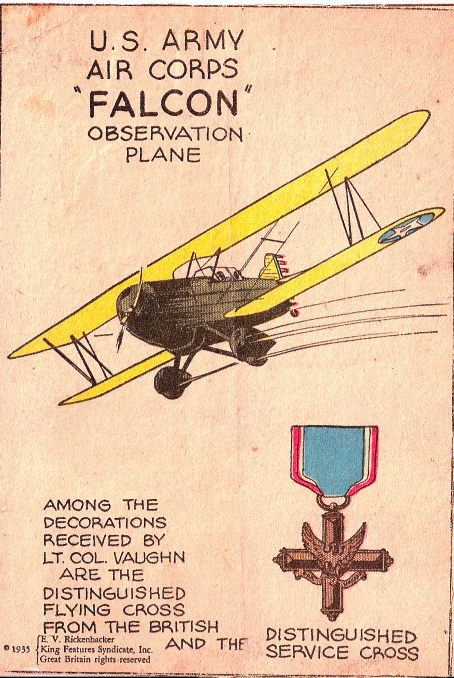
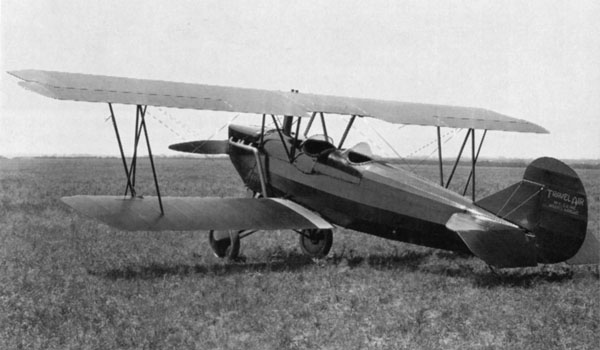
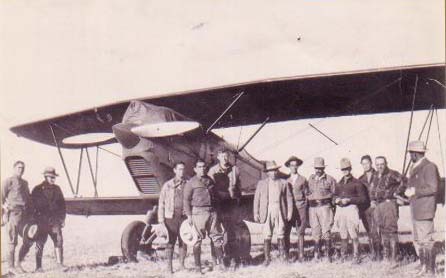
Curtiss O-1 Falcon
U.S. Army Air Corps observation plane
By Stephen Sherman, Apr. 2007. Updated July 23, 2011.
With its deep belly and swept-back wings, the Curtiss Falcon cut a dramatic picture in the air, serving with Army Air Corps squadrons, or flying during the Brazilian revolution of 1932, or more prosaically, delivering the US mail. About 300 were built, including the O-1 series observation planes, the A-3 attack aircraft, the F8C transport planes, and export versions. The O-1 Falcon was a conventional unequal-span biplane with a wood and cloth wings, swept back on the outer panels of the upper wing.
The
fuselage was built up from aluminium tubing with steel tie-rod bracing,
and the tail unit included a balanced rudder; the sturdy landing gear
was of tailskid type.
Development
It began as the XO-1 in 1924, when the Army sought to replace its
antiquated DH-4 observation planes. Still carrying hundreds of Liberty
engines in inventory, the entrants had to be able to use the
WWI-vintage, 420-hp engine. In that competition, Curtiss' biplane came
in second to a Douglas machine, but it got another chance the next
year, when the Army staged another competition. Aware that the Liberty
was getting long in the tooth, the Army specified the Packard 1A-1500,
a more advanced V-12 liquid-cooled engine rated at 510 hp, for its next
generation of observation machines. The Curtiss entrant won, and was
designated O-1; the Army ordered ten machines.
Inevitably problems and changes affected the O-1 series; a total of 127
were built. The Packard engine did not work out, so the 435 hp Curtiss
D-12 (V-1150) replaced it. With this less powerful engine, the O-1's
performance suffered. After the original order for ten O-1s, the Army
ordered forty-five O-1Bs, then forty-one of the O-1E, and then 30 of
the O-1G.
Improvements in the O-1B included wheel brakes, a droppable
56-gallon belly tank, and provisions for dumping the fuel in the
113-gallon main fuel tank. The attack version, the A-3, was essentially
similar to the O-1B. The O-1E was powered by a Curtiss V-1150E engine,
a development of the original Curtiss D-12; the O-1E also introduced
oleo-pneumatic shock-absorbers and horn balanced elevators. A few of
the various O-1 subtypes were converted to VIP transport aircraft.
Curtiss built another 66, designated O-11, powered by the aging Liberty
engine.
Attack Falcons
The A-3 was an attack version of the O-1B. Minor changes consisted
of adding bomb racks underneath the lower wings and installing a single
0.30-inch machine gun in each lower wing outboard of the propeller arc.
The A-3 was otherwise identical to the O-1B. The engine was the D-12D
(V-1150-3) rated at 435 hp. A total of 66 A-3s were ordered, the first
delivered on October 31, 1927. The A-3B was an attack version of the
later O-1E. 78 attack A-3Bs were delivered in 1929-30.
Mailplane
Twenty civil-use Falcons were built as mailplanes, nicknamed the Conqueror.The hazards of flying the mail in the 1930s are shown in this accident report of a Falcon mailplane on May 29, 1934: Lt Clarence F. Edge, with passenger Harry L. Sexton, US Collector of Customs at San Antonio, had taken off from Fort Bliss, El Paso. Shortly afterwards, the engine developed problems and Lt. Edge elected to return to the field. While landing the plane, it hit a rough spot on the field and nosed over into a sand hill. Gasoline from the wing tank began to leak and soon thereafter the plane was engulfed in flames. Lt Edge jumped from the rear cockpit and tried to pull the unconscious Sexton from the plane. Lt. Edge was severely burned on his face and arms from the gasoline feed fire before two others were able to pull him away from the burning plane. Lt Edge spent several weeks in the Fort Bliss Army Hospital recovering from his injuries. Mr. Sexton died in the crash.
South American Falcons
Several of these were sold to Colombia, Peru, Chile, and Brazil. In
Brazil, the Falcons were featured in the brief fighting during the
Constitutionalist Revolution of 1932, the uprising of the state of
São Paulo against the federal government of Brazil.
Operations
Sept. 1926 - The Army beat the Navy in the Liberty Engine Builders'
trophy race, Lieut. Orville L. Stephens coming home first in a Curtiss
Falcon observation plane after averaging 142.6 m.p.h. for a dozen laps
of a 12-mile course.
The O-1 Falcon was a successful observation plane, flown primarily by squadrons of the 9th Observation Group, based at Mitchel Field, New York. The A-3 Attack Falcon served with squadrons of the 3rd Attack Group, Barksdale Field, Louisiana, and the 26th Attack Squadron in Hawaii from 1928 to 1934 and with reserve units until 1937.