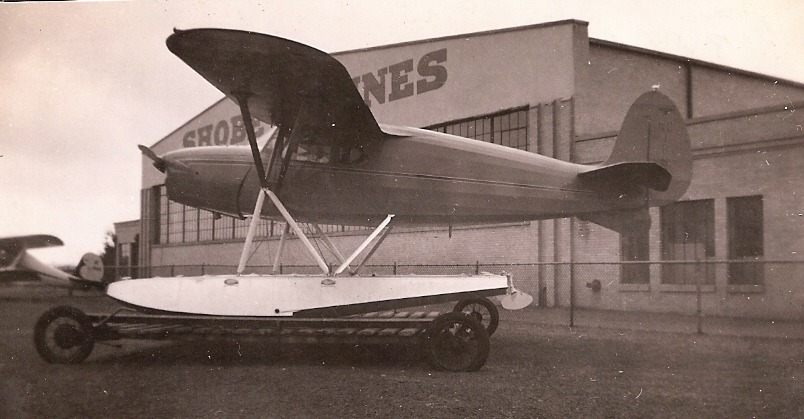
 Fairchild 24 equipped with floats.
East Boston airport, July 21, 1936
in front of Shobe Airlines hangar.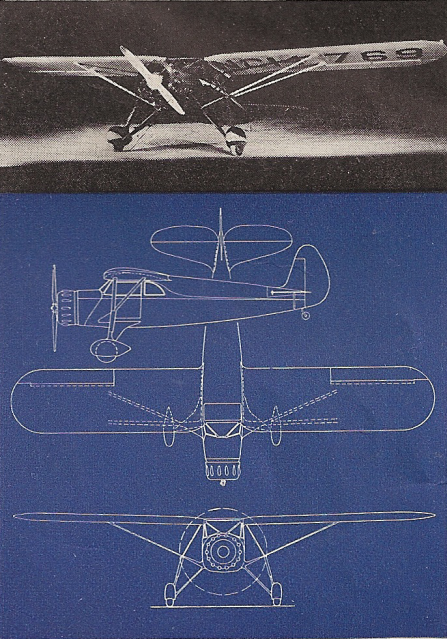
The Fairchild Model 24, a four-seat, single-engine monoplane, was in production from 1932 – 1946; altogether 2,232 were built. As a light transport aircraft used by the US Army Air Corps, it was designated UC-61. The Model 24 was itself a development of the earlier Fairchild Model 22.
Fairchild Aircraft was hit hard by the Great Depression as airline purchases of larger aircraft dried up, so the company developed a reliable and rugged small plane for personal and business use. The model 22 sold well and evolved into the new, improved Model 24, whose easy handling and roomy interior helped it gain popularity in the 1930s. Using many automobile components (expansion-shoe brakes and roll-down cabin windows), the aircraft was also affordable and easy to maintain. For its 15-year production life, the aircraft remained essentially unchanged aerodynamically and internally. The first models were equipped with only two seats, but in 1933 a third seat was installed and by 1938 a fourth was added.
You can read more at the Fairchild 24 site.
From Aero Digest, April, 1935:
Fairchild Aircraft Corporation, Hagerstown, Maryland
â€
Stephene,
This is an awesome photo! I am interested in knowing if you do infact still have the original of this photo. I think I remember reading somewhere that your father took these photos. My grandfather Albert Shobe (recently passed) told me that he used to be picked up by his father John Shobe in this exact plane. Just wondering if you have any information on my great grandfather or any other photos of Shobe Airlines. All information is very much appreciated! Thank you for sharing all of these great photos!!
-Kyle